What if one scientist’s work could change how we see the entire universe? This question drives the remarkable story of a pioneering researcher from Morocco.
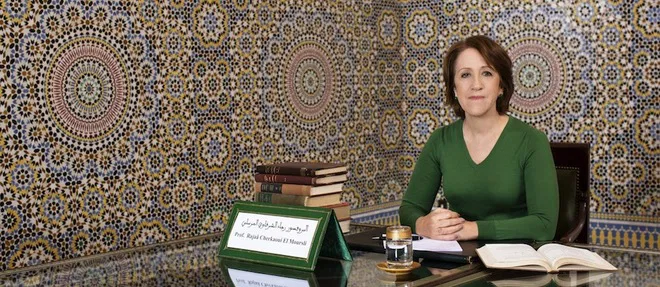
Rajaâ Cherkaoui El Moursli stands as a global leader in nuclear physics. Her career spans decades of groundbreaking research and international collaboration.
As a professor at Mohammad V University, she has made significant contributions to particle physics. Her work played a crucial part in the Higgs boson discovery at CERN.
Her achievements have earned prestigious awards worldwide. These include the L’Oréal-UNESCO Awards for Women in Science and the Breakthrough Prize.
Beyond her research, she advocates for women in STEM fields. She also works to build scientific infrastructure across Africa through her leadership roles.
Key Takeaways
- Pioneering work in nuclear physics with global impact
- Key contributor to the Higgs boson discovery at CERN
- Recipient of multiple prestigious international science awards
- Strong advocate for women’s participation in STEM fields
- Leadership in developing scientific infrastructure in Africa
- Professor at Mohammad V University advancing physics research
- Inspiration to future generations of scientists worldwide
Who Is Rajaâ Cherkaoui El Moursli: Early Life and Education
Every great journey begins with a single step. For this pioneering physicist, that journey started in a coastal Moroccan city.
Her early years laid the foundation for an extraordinary career in science. These formative experiences shaped her future contributions to physics.

Birth and Upbringing in Salé, Morocco
She was born on May 12, 1954, in the historic city of Salé. This coastal community near Rabat provided her cultural roots.
Growing up in Morocco during this period presented unique challenges. Traditional expectations often limited opportunities for young women.
Her family background played a crucial role in her development. Despite conservative norms, she received strong educational support.
Pursuing Higher Education in France
She earned her first degree in mathematics at Lycée Descartes in Rabat. This achievement marked her initial academic success.
Two key figures inspired her scientific ambitions. Neil Armstrong’s space achievements captured her imagination. A dedicated high school teacher also encouraged her physics interests.
She faced significant family discussions about studying abroad. Persuading her father required demonstrating her serious commitment to science.
Her move to Grenoble, France, opened new academic horizons. She enrolled at Joseph Fourier University for advanced studies.
Her doctoral research focused on subatomic and cosmic physics. She worked at the Laboratoire de Physique subatomique et cosmologie.
This French education provided cutting-edge technical knowledge. She gained experience with international research methodologies.
She returned to Rabat in 1982 with enhanced expertise. This homecoming began her professional career in Morocco.
Her overseas education directly influenced her future research approach. It prepared her for international scientific collaboration.
Scientific Contributions and Higgs Boson Research
International research collaborations have produced some of science’s greatest discoveries. The physicist’s work represents a perfect example of this global scientific partnership.
Key Role in the ATLAS Experiment at CERN
Her involvement with the ATLAS experiment marked a career highlight. This massive international project involved thousands of scientists worldwide.
She contributed significantly to particle physics research through data analysis. Her expertise helped interpret complex experimental results from particle collisions.
The research collaboration spanned multiple countries and institutions. This global effort required precise coordination and shared scientific vision.
Proof of the Higgs Boson and International Recognition
The Higgs boson discovery answered a fundamental physics question. This particle explains how matter acquires mass in our universe.
Her work provided crucial proof of the particle’s existence. The ATLAS experiment team specifically congratulated her for this contribution.
This achievement earned her the 2015 L’Oréal-UNESCO Awards for Women in Science. This prestigious award recognized both her scientific excellence and advocacy for women in research.
Beyond international recognition, she advanced Moroccan science education. She established the first master’s degree in medical physics at Mohammad V University.
This program raised the level of Moroccan research capabilities. It created new opportunities for students interested in advanced physics applications.
Her achievements demonstrate how individual dedication impacts global science. They also highlight Africa’s growing role in international research collaborations.
Leadership and Advocacy in Science
True scientific impact extends beyond laboratory discoveries to shaping the future of research itself. This visionary physicist expanded her influence through strategic leadership roles that transformed African science.
Her administrative work complemented her experimental achievements. She built frameworks that would outlast any single discovery.

Vice-Presidency at the African Academy of Sciences
She served as Vice President for Northern Africa on the governing council of the African Academy of Sciences. This position placed her at the heart of continental scientific decision-making.
The AAS governing council features diverse representation from across Africa. It includes eight elected members, two Kenyan nominees, and an African Union representative.
This leadership body oversees critical programs and policies. It manages fellowship programs that support emerging researchers.
Her role involved championing scientific excellence across Northern Africa. She advocated for equity and international collaboration in research initiatives.
Promoting Women in STEM and Building Scientific Infrastructure
Gender equity in science remained a central focus of her advocacy work. She implemented initiatives specifically designed to support women in STEM fields.
Mentoring young scientists became a priority throughout her career. She guided emerging talent in Morocco and across the continent.
Her efforts helped build sustainable scientific infrastructure. This included educational programs and modern research facilities.
She fostered partnerships that elevated Africa’s role in global research networks. These connections brought international resources to local projects.
Her work aligned perfectly with the AAS mission of transforming lives through science. She championed programs focused on gender equality and early career development.
This leadership demonstrated how individual contributions can build institutional strength. Her advocacy created lasting systems rather than temporary solutions.
Conclusion: Legacy and Lasting Impact
The most enduring scientific contributions build bridges that connect present achievements to future possibilities. This physicist’s work exemplifies this principle through groundbreaking research and strategic leadership.
Her governing council role at the African Academy of Sciences shaped continental research policies. She elevated regional science while championing international collaboration.
The Breakthrough Prize recognized her particle physics contributions, particularly the Higgs boson discovery. This honor highlighted Africa’s growing role in global scientific endeavors.
Her advocacy for women in STEM created lasting pathways for future researchers. She built scientific infrastructure that ensures sustainable progress across the continent.
This legacy continues to inspire new generations of scientists. It demonstrates how individual dedication can transform entire scientific communities worldwide.
FAQ
What is Rajaâ Cherkaoui El Moursli best known for?
She is best known for her significant role in the ATLAS experiment at CERN, which led to the discovery of the Higgs boson particle. This breakthrough confirmed a fundamental part of the Standard Model of particle physics.
How did she contribute to the advancement of science in Africa?
As a vice-president of the African Academy of Sciences, she has worked to strengthen scientific research and collaboration across the continent. She advocates for better infrastructure and more opportunities for scientists in Africa.
What awards has she received for her work?
She has earned international recognition, including the prestigious L’Oréal-UNESCO For Women in Science Award. This honor highlights her achievements and her efforts to support other women in scientific fields.
Why is her work on the Higgs boson important?
The discovery of the Higgs boson helps explain how particles acquire mass, a key question in physics. Her contributions were vital to this proof, enhancing our understanding of the universe’s basic building blocks.
What is her role in promoting women in science?
She is a strong advocate for gender equality in STEM. Through her leadership and public outreach, she inspires and supports the next generation of female researchers and scientists.