What if you could turn every “Wait, how do I do this?” question into an “Already done” action? Scattered knowledge and inconsistent training slow down teams. They create errors and hurt growth.
This is where a structured approach changes everything. A dedicated platform transforms your unique methods into scalable training. It makes your operations consistent and reliable.
Trusted by 10,000 high-performance teams, this solution has trained employees in over 150 countries. It maintains a stellar 4.7/5 rating from more than 1,000 reviews. This isn’t just another tool—it’s a complete system for business excellence.
This article will guide you through a clear comparison. We’ll show how modern training software outperforms old methods. You’ll see how to document processes, track progress, and ensure compliance. The goal is to help you make an informed choice for your team’s success.
Key Takeaways
- A centralized platform eliminates scattered documentation and creates a single source of truth.
- Structured training turns company processes into easy-to-follow, repeatable actions for all employees.
- Tracking and accountability features ensure everyone completes necessary learning and compliance requirements.
- Scalable systems grow with your business, maintaining consistency across teams and locations.
- High user ratings and global adoption signal a reliable, proven solution for operational excellence.
- Modern training software integrates knowledge management with employee development in one system.
- The right platform reduces errors, speeds up onboarding, and drives overall business performance.
The Modern Business Challenge: Scattered Knowledge and Inconsistent Training
When vital company knowledge lives in email threads, shared folders, and various apps, finding answers becomes a daily scavenger hunt. This fragmented approach creates real operational headaches.
Teams waste precious time searching through Google Drive, Slack channels, and old documents. There is no single source of truth for how work gets done. This scattered documentation hurts productivity across your entire organization.
Inconsistent training methods make this problem worse. Different managers teach processes their own way. New employees receive conflicting information about company policies.
This leads to varying performance quality between team members. Errors increase when people follow different procedures. Maintaining standards across departments becomes nearly impossible.
Onboarding new hires presents major challenges without standardized paths. Each manager creates their own training program from scratch. This results in longer ramp-up times and significant knowledge gaps.
Compliance risks grow when policies aren’t centrally managed. Outdated procedures remain in circulation because no system tracks updates. Important policy changes might never reach all employees.
Scattered documentation makes accountability difficult. Leaders cannot track who completed required training. There’s no clear record of who acknowledged important policy changes.
Using multiple tools for different functions creates unnecessary complexity. Separate systems handle SOPs, training, and knowledge bases. Employees must learn several platforms just to do their jobs.
This fragmented approach prevents businesses from scaling effectively. Adding team members multiplies the communication chaos. Growth exposes the weaknesses in disconnected systems.
The financial impact is substantial. Lost productivity drains resources every single day. Training inefficiencies cost money in repeated efforts. Potential compliance penalties create avoidable risks.
These challenges highlight the need for a unified solution. A platform like Trainual addresses these specific pain points. It brings order to the chaos of modern business operations.
Trainual: The All-in-One Platform for Process and Training Management
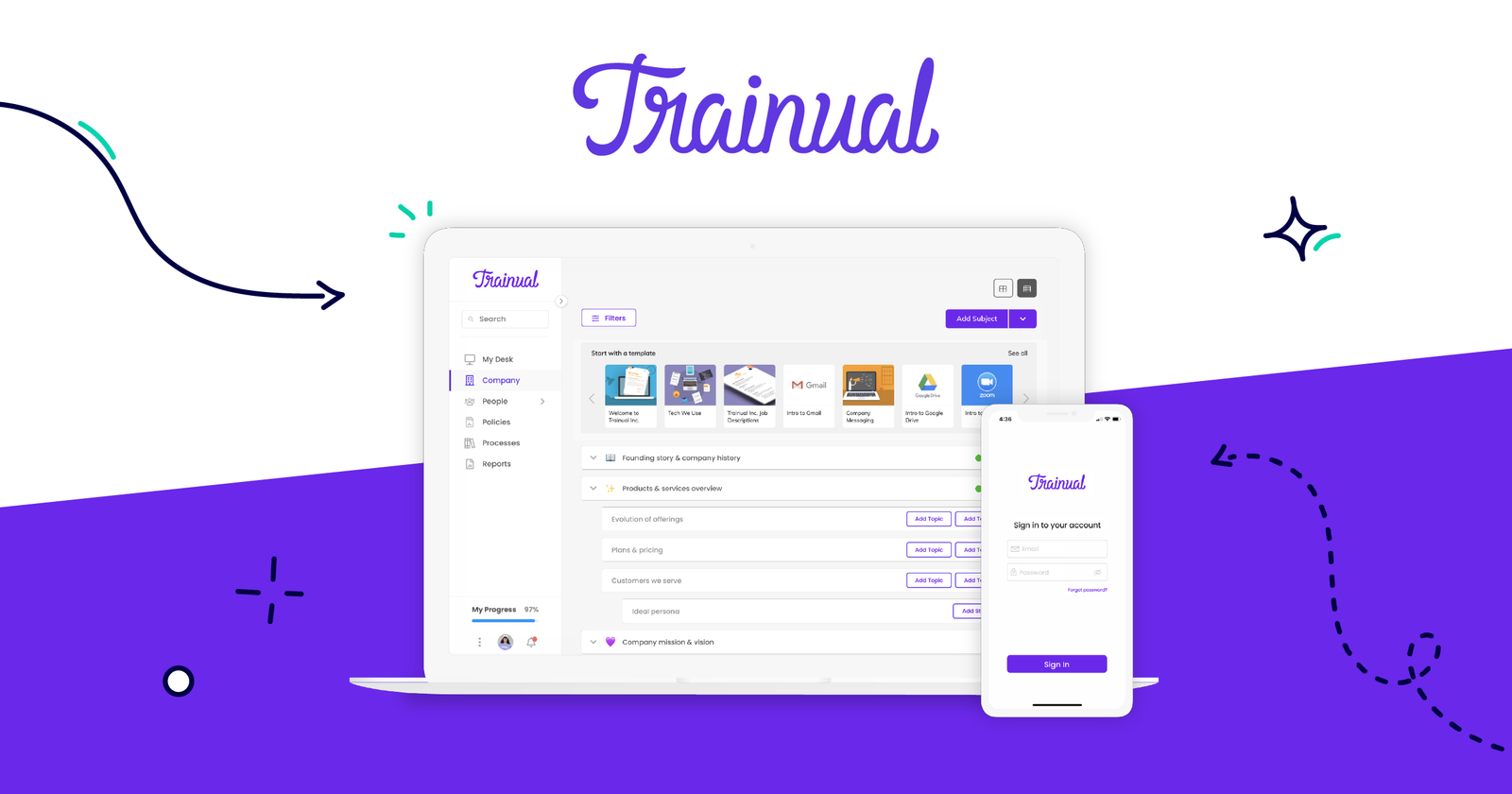
Operational excellence demands one unified system that handles both learning and execution. This comprehensive software consolidates process documentation, training management, and policy oversight into a single hub.
It creates a centralized knowledge base accessible to every team member. This eliminates the need for multiple disconnected tools.
The platform transforms standard operating procedures into interactive training modules. Employees follow clear, step-by-step instructions instead of reading static documents.
This approach drives consistency across all departments. Everyone follows the same approved methods for every task.
Content creation becomes straightforward with built-in tools. You can record videos, capture screen recordings, and design flowcharts directly within the system.
Auto-generated tests reinforce learning and verify comprehension. This ensures knowledge retention beyond initial training sessions.
Custom automated paths guide new hires through sequential assignments. Managers set specific learning requirements with timed delays between modules.
Real-time collaboration features enable teams to edit content together. Colleagues can leave comments and provide feedback directly in the system.
Version history tracking maintains a clear audit trail. You always know who made changes and when updates occurred.
The centralized knowledge management organizes all company information. Processes, policies, and best practices live in one searchable location.
AI-powered search functionality understands natural language questions. Employees get immediate answers from the knowledge base without manual searching.
A library of 500+ templates accelerates implementation. Done-for-you courses cover common training topics from safety to sales.
This solution serves as both a training platform and a single source of truth. It provides reliable access to approved procedures and current policies.
The system offers flexibility for existing documentation. You can upload current materials and integrate with other tools in your tech stack.
This creates a cohesive experience for all users. Teams work from one reliable source instead of scattered information.
Compliance becomes manageable with organized policy tracking. Required acknowledgments and training completions are easily monitored.
Leaders gain clear visibility into team progress and knowledge gaps. Data-driven insights help optimize training programs over time.
The platform scales with your business growth. Adding new team members or locations maintains operational consistency.
Trainual vs. Traditional Methods: A Side-by-Side Overview
Businesses often face a critical choice between maintaining familiar but fragmented systems or adopting a cohesive operational platform. This comparison highlights the practical differences that affect daily work.
Understanding these approaches helps leaders make informed decisions. The right choice impacts efficiency, cost, and team performance.
Traditional Approach: A Patchwork of Tools
Many companies rely on separate software for different functions. Google Docs might store SOPs while another system handles training courses.
SharePoint could manage policies, and a separate LMS delivers employee training. This creates multiple information silos across the organization.
Each tool requires its own login and has a different user interface. People waste time switching between applications just to complete basic tasks.
There is no integration between these disconnected systems. Data from one platform doesn’t connect with information from another.
This fragmentation creates significant administrative burden. Managers must monitor completion across several platforms.
Tracking compliance becomes a manual, error-prone process. Leaders lack a unified view of team progress and knowledge gaps.
Updating content requires changes in multiple places. A policy revision might need edits in documents, presentations, and training materials.
Version control issues arise when different systems contain conflicting information. Employees might follow outdated procedures without realizing it.
The cost implications are substantial. Maintaining multiple software subscriptions adds up quickly.
Each platform requires separate training for users and administrators. Support costs multiply with each additional tool in the tech stack.
New hires face a confusing array of systems during onboarding. They must learn where to find different types of information.
Accessibility is limited with traditional desktop-bound systems. Remote or mobile employees struggle to find what they need.
The Trainual Solution: Unified System
A comprehensive platform consolidates all these functions into one place. It serves as a single source of truth for processes, policies, and training.
This eliminates the need for multiple disconnected subscriptions. Teams access everything through one login with a consistent interface.
The centralized knowledge base organizes all company information. SOPs, training courses, and policy documents live together.
Structured, automated paths guide new hires through onboarding. The system sequences assignments with appropriate timing between modules.
Built-in progress tracking provides clear visibility into completion rates. Managers can view real-time data on team learning and compliance status.
Making updates becomes a once-and-done process. Change a procedure in the platform, and it updates everywhere automatically.
The mobile app extends knowledge access beyond the desktop. Employees can find information anywhere, improving response times.
Content history features maintain a clear audit trail of all changes. Real-time collaboration allows teams to work together on documentation.
Administration streamlines significantly with a single platform. One system manages user accounts, permissions, and reporting.
This unified approach reduces complexity for everyone involved. Employees spend less time searching and more time executing.
The platform scales efficiently as organizations grow. Adding new team members or locations maintains operational consistency.
Total cost often decreases despite increased functionality. One subscription replaces several separate software expenses.
Comparison Deep Dive: Documentation and Knowledge Management
The foundation of any efficient organization lies in how well it manages and shares its collective knowledge. Traditional systems often fail at this critical task. They scatter vital information across multiple platforms.
Modern software solutions take a completely different approach. They consolidate everything into a single, organized system. This transforms how teams access and use information daily.
Centralized SOP & Policy Hub
Scattered documents create confusion and inconsistency. Files living in different drives and folders become hard to track. Employees waste time searching instead of executing.
A unified platform changes this dynamic completely. It creates one central place for all standard operating procedures. Every policy and process document lives together in the same system.
This centralized approach eliminates version confusion. Everyone accesses the same current information. Updates apply universally across the organization.
Real-time collaboration features allow multiple team members to work together. They can edit documents simultaneously and leave feedback directly in the system. This streamlines the documentation process significantly.
The platform supports various content types to match different learning styles. Text, images, videos, and flowcharts all work within the same structure. Screen recordings can demonstrate complex procedures visually.
Migration becomes straightforward with robust upload capabilities. Existing documentation moves into the new system without starting from scratch. This preserves previous work while improving organization.
A library of 500+ templates accelerates content creation. Done-for-you courses cover common business topics. These resources save valuable development time.
Centralized documentation ensures consistency across all teams. Everyone follows the same approved methods. This reduces errors and improves quality control.
Version history provides a clear audit trail of all changes. Managers can see who updated content and when modifications occurred. This maintains accountability for documentation accuracy.
AI-Powered Search and Instant Answers
Traditional search functions rely on exact keyword matching. This often fails to deliver relevant results. Employees struggle to find what they need quickly.
Advanced platforms use semantic search technology instead. This understands the context and intent behind questions. It delivers more accurate answers to natural language queries.
Employees can ask questions just like they would ask a colleague. The system interprets their meaning and finds relevant information. Instant answers surface from the knowledge base within seconds.
This contrasts sharply with folder-based systems. Those require knowing exactly where documents are filed. Users must navigate complex directory structures.
The AI-powered approach understands synonyms and related concepts. It connects different pieces of information intelligently. This creates a more intuitive user experience.
Search results prioritize the most relevant content first. The system learns from user interactions over time. It continuously improves its ability to deliver correct answers.
This technology transforms the knowledge base into an active resource. Information becomes immediately accessible to everyone. Teams spend less time searching and more time applying knowledge.
The platform serves as a single source of truth for the entire organization. All data and information reside in one easily searchable location. This eliminates conflicting information from multiple sources.
Access control features ensure appropriate information security. Different user levels can view relevant content based on their roles. This maintains privacy while promoting knowledge sharing.
Compliance becomes easier to manage with organized policy documentation. Required acknowledgments track automatically within the system. Managers gain clear visibility into completion status.
Comparison Deep Dive: Training and Onboarding Execution
The execution phase separates successful onboarding programs from those that fail to deliver lasting results. How companies deliver and track learning determines real-world application. This comparison examines two critical execution areas.
First, automated training paths guide employees through structured learning. Second, built-in testing and reporting verify knowledge retention. Together, these features transform how organizations develop their people.
Automated and Trackable Training Paths
Traditional onboarding often relies on paper manuals and scheduled sessions. New hires receive binders filled with outdated information. Managers repeat the same presentations for each incoming group.
This approach lacks personalization and consistent timing. Employees progress at different rates but receive identical content. There’s no system to ensure everyone covers essential material.
Modern platforms create customized sequences for each role. The system sets prerequisites between learning modules. Timed delays ensure proper absorption before advancing.
Automatic progression occurs only after completing required content. This eliminates gaps in employee knowledge. Managers define the exact path each new hire follows.
The platform supports various learning styles through multiple formats. Videos demonstrate procedures visually. Text documents provide detailed reference material.
Flowcharts map complex processes clearly. Screen recordings show software navigation step-by-step. Interactive elements engage users throughout their learning journey.
Scalability becomes effortless with this automated approach. Training unlimited employees maintains consistent quality. Content updates apply universally across all users.
This contrasts sharply with manual training methods. Those require repeating sessions for each new group. Consistency suffers when different trainers deliver material.
Built-in Testing, Reporting, and Compliance
Knowledge verification separates effective training from simple content delivery. Traditional methods often lack systematic assessment. Managers guess whether employees understand critical procedures.
Modern systems include auto-generated tests and interactive quizzes. These features reinforce key concepts immediately. Knowledge checks appear throughout the learning process.
Completion reports provide clear visibility into progress. Managers view assessment scores and time spent on each module. People reports show individual and team performance data.
Progress bars visually represent completion status. Leaders quickly identify who needs additional support. This data-driven approach improves training effectiveness.
Compliance features ensure regulatory requirements get met. Built-in e-signatures capture policy acknowledgments electronically. Completion certificates provide formal verification records.
The platform includes pre-built compliance courses for common regulations. These ready-made resources save development time. Businesses meet requirements without creating content from scratch.
Verification reminders alert managers about expiring certifications. Due dates and automatic notifications keep teams on track. The system sends alerts when changes require renewed acknowledgment.
Administrative overhead reduces significantly with these automated features. Manual tracking spreadsheets become unnecessary. The platform handles reminders, due dates, and expiration notifications.
Audit readiness improves with organized documentation. All completions and acknowledgments store in one central location. Reports generate instantly for compliance reviews.
This comprehensive approach saves managers considerable time. They ensure all employees receive consistent, current training. The system handles routine tracking and notification tasks.
Employees benefit from clear expectations and structured learning. They know exactly what they need to complete. Progress tracking provides motivation through visible achievement.
The right platform transforms training from an administrative task to a strategic advantage. Execution features ensure learning translates into workplace performance. Companies gain confidence in their team’s capabilities.
Comparison Deep Dive: Accessibility, Accountability, and Integration
Modern teams demand access to knowledge wherever work happens, not just at a desktop computer. The final comparison examines how systems handle real-world usage. It covers mobile access, progress visibility, and connection with other tools.
These elements determine daily efficiency for distributed teams. They separate systems that integrate with workflow from those that disrupt it.
The Mobile App: Knowledge in Your Pocket
Traditional training software often ties learning to office computers. This creates barriers for field teams and remote employees. Mobile accessibility changes this dynamic completely.
A dedicated app puts your entire knowledge base in everyone’s hand. Team members can reference SOPs during client meetings. They check policies while traveling between locations.
The search function understands natural language questions. Employees type queries like they would ask a colleague. Instant answers surface from approved documentation.
Training doesn’t stop when people leave their desks. The app allows completing courses during downtime. Tests and e-signatures happen directly on mobile devices.
Real-time updates ensure everyone has current information. Notifications alert users when processes change. This keeps field teams synchronized with office policies.
Store reviews highlight strong performance for mobile access. Users appreciate having business answers during site visits. The 4.2 rating reflects reliable field functionality.
This approach increases adoption across all employee groups. People use the system because it fits their workflow. Knowledge becomes truly accessible anywhere.
Clear Accountability with Progress Tracking
Visibility separates hope from certainty in employee development. Traditional methods rely on manual check-ins and spreadsheets. Modern systems provide real-time data dashboards.
Individual progress bars show completion status at a glance. Managers see who needs support without asking. This saves considerable administrative time.
Completion reports detail exactly what each person finished. People reports aggregate data across teams and departments. Leader dashboards highlight knowledge gaps before they cause problems.
The platform maps organizational structure visually. Interactive charts show reporting relationships clearly. Role charts define responsibilities for every position.
Delegation planning becomes straightforward with this visibility. Managers can temporarily assign duties during absences. Everyone understands who handles each process.
Accountability extends beyond basic training completion. The system tracks policy acknowledgments and certification renewals. Compliance requirements become manageable rather than overwhelming.
This transparency benefits both leaders and team members. Employees know exactly what’s expected of them. Managers have data to support development conversations.
Connecting Your Tech Stack
No business system operates in complete isolation. Effective platforms integrate with existing tools rather than replacing them. This reduces manual work and data silos.
HRIS synchronization keeps employee records current automatically. New hires appear in the training system without manual entry. Role changes flow between platforms seamlessly.
Payroll software connections ensure compensation alignment. Completed training can trigger compensation milestones. This automates previously manual processes.
Slack integration brings knowledge into daily communication. Team members can search documentation without leaving their chat platform. This creates a natural workflow for finding answers.
A software management feature catalogs all business tools in one place. Each application shows login information and help documentation. Assigned owners and team associations are clearly visible.
This creates a central directory for your entire technology ecosystem. New employees learn what tools they need for their role. Teams understand which software supports each process.
Integration capabilities reduce administrative overhead significantly. Data flows between systems without manual transfer. Updates in one platform reflect across connected tools.
The result is a cohesive technology environment. Training and documentation connect with other business functions. Information moves freely rather than getting stuck in silos.
This approach supports scalable growth across organizations. Adding new tools integrates smoothly with existing systems. The platform becomes the connective tissue for operations.
Conclusion: Is Trainual the Right Choice for Streamlining Your Operations?
The decision to modernize training and documentation hinges on measurable returns and team adoption. This platform delivers both through centralized knowledge management and automated learning paths.
Businesses gain clear advantages with consistent process documentation and trackable employee training. Reduced onboarding time and fewer errors translate directly to cost savings. Compliance becomes manageable with organized policy updates.
Over 10,000 teams globally use this approach. They achieve faster ramp-up for new hires and maintain quality standards. The 4.7/5 rating from 1,000+ reviews confirms its effectiveness.
For growing companies with distributed teams, Trainual offers a unified solution. It turns complex processes into scalable training that drives operational excellence. The platform provides the structure teams need to work efficiently.
FAQ
How does a training platform improve our onboarding process?
A dedicated training platform automates and organizes your onboarding. It creates clear paths for new hires, ensuring they get consistent information. You can track their progress and completion of essential policies and SOPs. This replaces messy handbooks and scattered files, saving managers time and getting employees productive faster.
What makes a good knowledge management system for our team?
An effective knowledge base is centralized, searchable, and always up-to-date. It should be the single source of truth for all your processes, policies, and training content. Look for features like powerful search, easy editing, and version control. This ensures every employee, from new hires to veterans, can find accurate answers instantly without interrupting others.
Can training software help with compliance and accountability?
Absolutely. Modern training software provides detailed reporting on course completion and assessment scores. This creates an audit trail for compliance requirements. Managers gain visibility into who has completed mandatory training on policies. This data protects your business and holds everyone accountable for their required learning.
Is it difficult to move our existing processes onto a new platform?
Many platforms are designed for easy migration. You can often upload documents, videos, and existing SOPs directly. The key is choosing software that allows you to structure content logically. The initial setup organizes your knowledge, making it far easier to manage and update long-term compared to keeping files across drives, emails, and apps.
How does a mobile app benefit employee training?
A mobile app puts your knowledge base and training courses in an employee’s pocket. Team members can quickly look up a process on the sales floor or complete a training module during downtime. This increases access and engagement, supporting deskless workers and reinforcing learning anytime, anywhere.