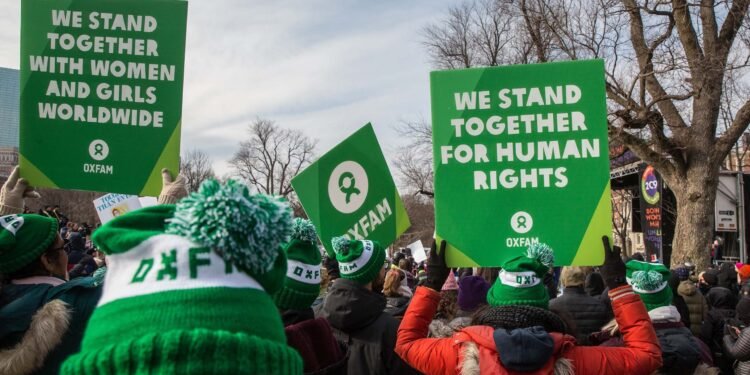
If poverty is shaped by power, then women’s empowerment must also be about who gets to speak, decide, organize, and challenge unfair systems. That is the space where Oxfam is most relevant in the MENA region.
Key Takeaways
- Oxfam is an international NGO network focused on ending poverty and injustice, with gender justice as a core part of its work.
- In MENA, Oxfam has supported women’s rights organizations, feminist activists, gender-based violence services, legal advocacy, and research on gender justice in conflict and fragility.
- Oxfam’s work is especially relevant because it connects women’s rights to economic inequality, climate justice, civic space, care work, and humanitarian crises.
- For Bahiyat readers, Oxfam offers a systems-level lens on women’s empowerment: not only how women survive, but how they gain power collectively.
Why Oxfam Matters In MENA
Oxfam is known globally for humanitarian response, anti-poverty work, and campaigns against inequality. In the MENA region, its gender justice work is important because women’s rights are affected by more than personal ambition. They are shaped by laws, economic systems, conflict, climate pressure, public services, social norms, and the strength of feminist movements.
Oxfam’s approach is especially relevant in contexts where women and girls face both immediate risks and structural inequality. A woman may need protection from violence, but she may also need legal reform, income, safe civic space, fair services, and public recognition of unpaid care work. Oxfam is useful because it connects these layers instead of treating gender equality as a narrow social issue.
How Oxfam Supports Women’s Rights And Gender Justice
Feminist Movements And Women’s Rights Organizations
Oxfam works with local partners, feminist activists, and women’s rights organizations. This matters in MENA because local women’s movements often understand the risks, language, culture, and political context better than any outside actor can. Supporting them can make change more grounded and more durable.
In its regional gender justice work, Oxfam has supported spaces for feminist dialogue, mentorship, cross-country learning, and advocacy. These spaces matter because activists and organizations need safety, solidarity, knowledge exchange, and resources to continue their work.
Gender-Based Violence Services And Legal Frameworks
Oxfam has highlighted work in MENA that strengthens services for survivors of gender-based violence, challenges harmful norms, and advocates for stronger legal frameworks. This is essential because violence limits women’s movement, health, income, education, public participation, and leadership.
Ending violence against women is not only about response services. It also requires prevention, community-level norm change, survivor-centered support, legal accountability, and institutions that take women’s safety seriously.
Gender Justice In Conflict And Fragility
Oxfam has researched gender justice, conflict, and fragility in MENA contexts including Egypt, Iraq, the occupied Palestinian territory, and Yemen. This work is important because crisis can intensify existing inequalities. Women may face increased violence, loss of income, displacement, care burdens, reduced health access, and exclusion from recovery decisions.
In fragile settings, women’s rights should not be postponed until after stability returns. They are part of what makes recovery fair and sustainable.
Climate Justice And Women’s Health
Oxfam has also examined the relationship between climate change, women’s health, and rights in MENA. This is increasingly relevant because the region is highly exposed to heat, water stress, food insecurity, and extreme weather. Climate impacts can affect women’s livelihoods, safety, health, care responsibilities, and access to services.
For women’s empowerment, climate justice means asking who is most affected, who has resources to adapt, and who is included in decisions about the future.
Economic Inequality And Care Work
Oxfam’s gender justice work is closely tied to economic inequality. Women and girls often carry unpaid care work that keeps households and communities functioning, yet this work is undervalued and rarely reflected in economic policy. In MENA, care responsibilities can strongly affect whether women can study, work, start businesses, or participate in leadership.
Oxfam’s lens helps shift the conversation from individual effort to systems. If care work remains invisible, women’s economic empowerment will remain incomplete.
Why Oxfam Is Relevant Across Saudi Arabia, UAE, Egypt, Morocco, And MENA
For Egypt and Morocco, Oxfam’s work is relevant to civil society, legal reform, economic inequality, climate justice, and women’s rights advocacy. For Saudi Arabia and the UAE, Oxfam’s lens is useful for philanthropy, corporate impact, climate commitments, humanitarian partnerships, and regional policy conversations. Across the wider MENA region, Oxfam is especially relevant where conflict, displacement, climate stress, and public service gaps shape women’s lives.
Its work reminds the region that women’s empowerment cannot be reduced to representation alone. Representation matters, but so do rights, resources, safety, collective power, and the ability to challenge unfair systems.
What Makes Oxfam Different
Oxfam’s distinctive value is its justice language. It does not only ask how women can adapt to unequal systems. It asks how those systems should change. That makes Oxfam especially important for readers interested in gender justice, feminist organizing, economic inequality, and advocacy.
For Bahiyat’s audience, Oxfam is a useful organization to understand because it connects women’s empowerment to bigger structural questions: Who controls resources? Whose labor is valued? Whose rights are protected? Whose voice is heard? Whose safety is treated as urgent?
FAQ About Oxfam
What is Oxfam?
Oxfam is an international NGO network working to end poverty and injustice through humanitarian response, advocacy, development programs, and partnerships with local communities and movements.
What does Oxfam do for women in MENA?
Oxfam supports gender justice through women’s rights organizations, feminist movements, gender-based violence services, legal advocacy, climate justice, research, and work on economic inequality.
Why is Oxfam important for gender justice?
Oxfam is important because it links women’s rights to power, poverty, economic systems, civic space, climate justice, and structural inequality.
Does Oxfam work on gender-based violence?
Yes. Oxfam supports efforts to strengthen services for survivors, challenge harmful norms, and advocate for better legal and policy frameworks.
Is Oxfam relevant to women’s economic empowerment?
Yes. Oxfam’s work on inequality, care work, livelihoods, climate justice, and rights is directly connected to women’s economic participation and agency.