
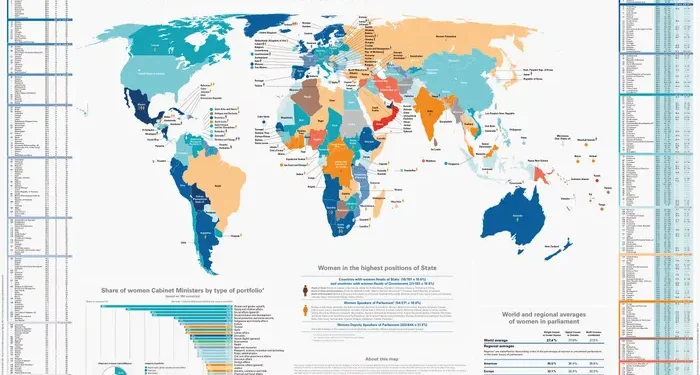
In 2026, we continue to see a political world in which men dominate the highest levels of authority. The latest IPU–UN Women data (Women in Politics Report 2026), we continue to see a political world in which men dominate the highest levels of authority. The latest IPU–UN Women data show that women remain significantly underrepresented in executive government, cabinet leadership, parliamentary seats, and parliamentary speaker roles. As of 1 January 2026, women serve as heads of state and/or government in only 28 countries, hold 22.4% of cabinet minister positions, and account for approximately 27.4%–27.5% of parliamentary seats worldwide.
These figures reveal a clear imbalance: women represent roughly half of the world’s population, yet they remain far from half of the world’s political decision-makers. We cannot describe this as a minor representation gap; it is a structural power gap that affects who sets budgets, who designs security policy, who negotiates peace, who writes laws, and who defines national priorities.
Key Findings on Women’s Political Representation in 2026
| Indicator | 2026 Global Status |
|---|---|
| Countries led by a woman head of state and/or government | 28 countries |
| Women in cabinet minister positions | 22.4% |
| Women in national parliaments | Around 27.5% |
| Countries with gender parity in cabinet | 14 countries |
| Countries with no women ministers | 8 countries |
| Women Speakers of Parliament | 54, or 19.9% of Speakers |
| Women MPs reporting intimidation by the public | 76% |
The most serious warning sign is not only that representation remains low, but that progress is slowing or reversing in key areas. Women’s share of cabinet positions fell from 23.3% in 2024 to 22.4% in 2026, while women’s parliamentary representation increased by only 0.3 percentage points from 2025 to 2026, matching the slowest growth rate recorded since 2017.
Women Heads of State and Government in 2026
At the top of political power, women remain rare. In 2026, only 28 countries are led by a woman head of state or government, while 101 countries have never had a woman leader.
This matters because the head of state or government often shapes the political agenda, represents the nation internationally, appoints senior officials, influences crisis response, and defines the tone of public leadership. When women are absent from these roles, national decision-making remains incomplete.
UN Women’s broader facts and figures further show that, as of 1 January 2026, there are 30 women serving as heads of state and/or government across 28 countries, with 16 countries having a woman head of state and 21 countries having a woman head of government. At the current rate, gender equality in the highest positions of power is still projected to be about 130 years away.
Women in Cabinets: Executive Power Is Still Unequal
Cabinet positions are among the most powerful offices in government. Ministers control policy areas, supervise public administration, propose reforms, manage national budgets, and influence legislation. Yet women hold only 22.4% of cabinet minister positions globally in 2026.
This is especially concerning because cabinet representation has moved backward. The global share of women ministers declined from 23.3% in 2024 to 22.4% in 2026, showing that gains in women’s political leadership are not guaranteed.
Only 14 countries have achieved gender parity in cabinet, while eight countries still have no women ministers at all.
The Gendered Division of Ministerial Portfolios
Women who reach cabinet are not equally distributed across all policy areas. The 2026 IPU–UN Women data show that women are more likely to lead portfolios associated with gender equality, family affairs, children, human rights, social inclusion, and social protection. Men continue to dominate portfolios such as defence, home affairs, justice, economic affairs, governance, public administration, housing, infrastructure, health, and education.
This pattern matters because ministerial assignments determine influence. A government may appoint women to cabinet while still excluding them from the portfolios that control budgets, security, macroeconomic policy, infrastructure, taxation, policing, and institutional reform. In 2026, women lead 90% of gender equality ministries and 73% of ministries responsible for family and children’s affairs, reinforcing long-standing stereotypes about which policy areas are considered “appropriate” for women.
Women in Parliament 2026: Slow Growth, Uneven Progress
Women hold about 27.5% of national parliamentary seats worldwide as of 1 January 2026, up from 27.2% in 2025. The increase of only 0.3 percentage points marks the second consecutive year of the slowest growth since 2017.
Parliaments are central to representative democracy. They pass laws, scrutinize government, approve budgets, debate national priorities, and represent citizens. When women hold just over one quarter of parliamentary seats, the legislature cannot fully reflect the people it serves.
The April 2026 IPU Parline ranking shows a global parliamentary average of 27.5% women across all chambers, with 27.3% in lower or unicameral chambers and 28.2% in upper chambers.
Regional Trends in Women’s Parliamentary Representation
Women’s representation varies sharply by region. As of April 2026, IPU Parline reports the following regional averages across all parliamentary chambers:
| Region | Women in Parliament |
|---|---|
| Americas | 36.1% |
| Europe | 32.3% |
| Sub-Saharan Africa | 26.8% |
| Asia | 22.5% |
| Pacific | 24.3% |
| Middle East and North Africa | 16.2% |
The Americas lead globally, while the Middle East and North Africa remain the lowest-performing region, with women holding only 16.2% of parliamentary seats on average.
Countries Leading Women’s Representation in Parliament
Several countries demonstrate that gender-balanced political representation is achievable. As of April 2026, Rwanda ranks first globally, with women holding 63.8% of seats in its lower chamber. Cuba follows with 57.2%, Nicaragua with 56.0%, Costa Rica with 52.6%, Bolivia with 50.8%, Mexico with 50.4%, and Andorra and the United Arab Emirates at 50.0%.
These examples matter because they show that parity is not theoretical. It can be reached through constitutional design, electoral rules, party commitments, quotas, candidate pipelines, and political will.
Countries with No Women in the Lower or Single Chamber
The global picture also includes severe exclusion. As of April 2026, Oman, Tuvalu, and Yemen have 0 women in their lower or single parliamentary chambers.
These cases show that women’s political participation cannot be treated as a natural outcome of elections alone. Without deliberate mechanisms to remove barriers, some political systems continue to reproduce complete exclusion.
Parliamentary Leadership: Women Speakers Decline
Women are also losing ground in parliamentary leadership. In 2026, only 54 women serve as Speakers of Parliament worldwide, representing 19.9% of all Speakers. This is a decline from 23.7% the previous year and marks the first drop in women Speakers in 21 years.
Speaker roles are powerful because they influence parliamentary procedure, debate, agenda management, institutional culture, and the functioning of democratic oversight. A decline in women Speakers means that women are not only underrepresented among legislators; they are also underrepresented in the leadership positions that shape how legislatures operate.
Quotas and Political Will: What Works
The 2026 data confirm that quotas remain one of the strongest tools for increasing women’s representation. In 2025, parliamentary chambers with legislated or voluntary quotas elected or appointed an average of 30.9% women, compared with 23.3% in chambers without quotas.
Well-designed quotas work best when they are enforceable, transparent, and supported by placement rules that prevent parties from nominating women only in unwinnable seats. Quotas should also be paired with campaign finance access, leadership training, anti-harassment protections, childcare support, and internal party reforms.
Violence and Intimidation Against Women in Politics
Women in politics face rising hostility both online and offline. The 2026 IPU report cited by IPU and UN Women found that 76% of women parliamentarians surveyed reported intimidation by the public, compared with 68% of men.
This hostility is not a side issue. Violence, harassment, sexist abuse, and threats discourage women from running for office, push elected women out of public life, and narrow democratic participation. Political violence against women therefore harms both individual leaders and democratic institutions.
Why Women’s Political Representation Matters
When women are excluded from political leadership, societies lose experience, expertise, and perspectives that are essential to public decision-making. We see the consequences in peace and security, economic policy, social protection, health, education, climate resilience, justice, and public trust.
Women’s representation is not only about numerical fairness. It is about institutional legitimacy. A democracy that excludes women from power cannot fully claim to represent its population. A cabinet that assigns women mainly to social portfolios cannot claim full equality. A parliament where women hold only around one quarter of seats cannot fully reflect the diversity of citizens’ lives.
The Political Pipeline: From Candidate Selection to National Leadership
Women’s underrepresentation at the top often begins much earlier in the political pipeline. Candidate recruitment, party financing, media coverage, local political networks, security risks, family responsibilities, and internal party gatekeeping all affect who gets nominated and who can win.
This pipeline shows why we cannot solve the leadership gap only at the final stage. We must address recruitment, nomination, campaign financing, political safety, leadership promotion, and cabinet appointment together.
A Practical Roadmap to Gender Parity in Politics
To move from slow progress to structural change, we should focus on reforms that directly affect power:
1. Adopt Enforceable Gender Quotas
Quotas should include clear targets, penalties for non-compliance, and placement rules. Without enforcement, quotas can become symbolic. With enforcement, they can reshape candidate lists and parliamentary outcomes.
2. Reform Political Party Recruitment
Parties remain the gatekeepers of political careers. We should require parties to publish gender-disaggregated candidate data, track nomination outcomes, and create leadership pipelines for women at local, regional, and national levels.
3. Fund Women Candidates Equitably
Women candidates often face unequal access to donors, party resources, and campaign networks. Public financing, spending transparency, and targeted support mechanisms can reduce the financial barriers that keep women out of competitive races.
4. Protect Women in Public Life
Governments, parliaments, parties, and digital platforms should treat violence against women in politics as a democratic threat. Protection must include legal remedies, rapid-response mechanisms, online abuse reporting, physical security support, and sanctions against perpetrators.
5. End Portfolio Segregation in Cabinets
Cabinet parity must include powerful portfolios. Women should not be concentrated only in gender, family, children, or social inclusion ministries. Equal political power requires women’s leadership in finance, defence, justice, infrastructure, interior affairs, foreign affairs, health, education, and economic planning.
6. Track Progress Publicly
Governments and parliaments should publish annual gender representation dashboards covering candidates, elected officials, committee chairs, ministers, speakers, party leaders, local officials, and senior civil servants. Measurement creates accountability.
Women in Politics 2026: Frequently Asked Questions
How many countries are led by women in 2026?
As of 1 January 2026, women serve as heads of state and/or government in 28 countries.
What percentage of cabinet ministers are women in 2026?
Women hold 22.4% of cabinet minister positions globally in 2026.
What percentage of parliamentarians are women worldwide?
Women hold about 27.5% of parliamentary seats worldwide as of 2026.
Which country has the highest share of women in parliament?
Rwanda ranks first in the April 2026 IPU Parline ranking, with women holding 63.8% of seats in its lower chamber.
Which regions have the highest and lowest women’s parliamentary representation?
The Americas lead with 36.1% women across all parliamentary chambers, while the Middle East and North Africa have the lowest regional average at 16.2%.
Do gender quotas improve women’s representation?
Yes. In 2025, chambers with legislated or voluntary quotas elected or appointed an average of 30.9% women, compared with 23.3% in chambers without quotas.
Conclusion: Equal Political Power Remains Unfinished Business
Women in politics in 2026 face a paradox. We have enough evidence to know what improves representation, yet progress remains slow, uneven, and reversible. We have countries that prove parity is possible, yet many systems continue to exclude women from legislatures, cabinets, party leadership, and executive office.
The central lesson is clear: women’s political equality does not advance automatically. It advances when institutions change the rules of access to power. We need enforceable quotas, safer political environments, fair campaign financing, transparent party recruitment, equal cabinet appointments, and public accountability.
Until women hold equal power in parliaments, cabinets, and executive leadership, democracy remains incomplete.) show that women remain significantly underrepresented in executive government, cabinet leadership, parliamentary seats, and parliamentary speaker roles. As of 1 January 2026, women serve as heads of state and/or government in only 28 countries, hold 22.4% of cabinet minister positions, and account for approximately 27.4%–27.5% of parliamentary seats worldwide.
These figures reveal a clear imbalance: women represent roughly half of the world’s population, yet they remain far from half of the world’s political decision-makers. We cannot describe this as a minor representation gap; it is a structural power gap that affects who sets budgets, who designs security policy, who negotiates peace, who writes laws, and who defines national priorities.
Key Findings on Women’s Political Representation in 2026
| Indicator | 2026 Global Status |
|---|---|
| Countries led by a woman head of state and/or government | 28 countries |
| Women in cabinet minister positions | 22.4% |
| Women in national parliaments | Around 27.5% |
| Countries with gender parity in cabinet | 14 countries |
| Countries with no women ministers | 8 countries |
| Women Speakers of Parliament | 54, or 19.9% of Speakers |
| Women MPs reporting intimidation by the public | 76% |
The most serious warning sign is not only that representation remains low, but that progress is slowing or reversing in key areas. Women’s share of cabinet positions fell from 23.3% in 2024 to 22.4% in 2026, while women’s parliamentary representation increased by only 0.3 percentage points from 2025 to 2026, matching the slowest growth rate recorded since 2017.
Women Heads of State and Government in 2026
At the top of political power, women remain rare. In 2026, only 28 countries are led by a woman head of state or government, while 101 countries have never had a woman leader.
This matters because the head of state or government often shapes the political agenda, represents the nation internationally, appoints senior officials, influences crisis response, and defines the tone of public leadership. When women are absent from these roles, national decision-making remains incomplete.
UN Women’s broader facts and figures further show that, as of 1 January 2026, there are 30 women serving as heads of state and/or government across 28 countries, with 16 countries having a woman head of state and 21 countries having a woman head of government. At the current rate, gender equality in the highest positions of power is still projected to be about 130 years away.
Women in Cabinets: Executive Power Is Still Unequal
Cabinet positions are among the most powerful offices in government. Ministers control policy areas, supervise public administration, propose reforms, manage national budgets, and influence legislation. Yet women hold only 22.4% of cabinet minister positions globally in 2026.
This is especially concerning because cabinet representation has moved backward. The global share of women ministers declined from 23.3% in 2024 to 22.4% in 2026, showing that gains in women’s political leadership are not guaranteed.
Only 14 countries have achieved gender parity in cabinet, while eight countries still have no women ministers at all.
The Gendered Division of Ministerial Portfolios
Women who reach cabinet are not equally distributed across all policy areas. The 2026 IPU–UN Women data show that women are more likely to lead portfolios associated with gender equality, family affairs, children, human rights, social inclusion, and social protection. Men continue to dominate portfolios such as defence, home affairs, justice, economic affairs, governance, public administration, housing, infrastructure, health, and education.
This pattern matters because ministerial assignments determine influence. A government may appoint women to cabinet while still excluding them from the portfolios that control budgets, security, macroeconomic policy, infrastructure, taxation, policing, and institutional reform. In 2026, women lead 90% of gender equality ministries and 73% of ministries responsible for family and children’s affairs, reinforcing long-standing stereotypes about which policy areas are considered “appropriate” for women.
Women in Parliament 2026: Slow Growth, Uneven Progress
Women hold about 27.5% of national parliamentary seats worldwide as of 1 January 2026, up from 27.2% in 2025. The increase of only 0.3 percentage points marks the second consecutive year of the slowest growth since 2017.
Parliaments are central to representative democracy. They pass laws, scrutinize government, approve budgets, debate national priorities, and represent citizens. When women hold just over one quarter of parliamentary seats, the legislature cannot fully reflect the people it serves.
The April 2026 IPU Parline ranking shows a global parliamentary average of 27.5% women across all chambers, with 27.3% in lower or unicameral chambers and 28.2% in upper chambers.
Regional Trends in Women’s Parliamentary Representation
Women’s representation varies sharply by region. As of April 2026, IPU Parline reports the following regional averages across all parliamentary chambers:
| Region | Women in Parliament |
|---|---|
| Americas | 36.1% |
| Europe | 32.3% |
| Sub-Saharan Africa | 26.8% |
| Asia | 22.5% |
| Pacific | 24.3% |
| Middle East and North Africa | 16.2% |
The Americas lead globally, while the Middle East and North Africa remain the lowest-performing region, with women holding only 16.2% of parliamentary seats on average.
Countries Leading Women’s Representation in Parliament
Several countries demonstrate that gender-balanced political representation is achievable. As of April 2026, Rwanda ranks first globally, with women holding 63.8% of seats in its lower chamber. Cuba follows with 57.2%, Nicaragua with 56.0%, Costa Rica with 52.6%, Bolivia with 50.8%, Mexico with 50.4%, and Andorra and the United Arab Emirates at 50.0%.
These examples matter because they show that parity is not theoretical. It can be reached through constitutional design, electoral rules, party commitments, quotas, candidate pipelines, and political will.
Countries with No Women in the Lower or Single Chamber
The global picture also includes severe exclusion. As of April 2026, Oman, Tuvalu, and Yemen have 0 women in their lower or single parliamentary chambers.
These cases show that women’s political participation cannot be treated as a natural outcome of elections alone. Without deliberate mechanisms to remove barriers, some political systems continue to reproduce complete exclusion.
Parliamentary Leadership: Women Speakers Decline
Women are also losing ground in parliamentary leadership. In 2026, only 54 women serve as Speakers of Parliament worldwide, representing 19.9% of all Speakers. This is a decline from 23.7% the previous year and marks the first drop in women Speakers in 21 years.
Speaker roles are powerful because they influence parliamentary procedure, debate, agenda management, institutional culture, and the functioning of democratic oversight. A decline in women Speakers means that women are not only underrepresented among legislators; they are also underrepresented in the leadership positions that shape how legislatures operate.
Quotas and Political Will: What Works
The 2026 data confirm that quotas remain one of the strongest tools for increasing women’s representation. In 2025, parliamentary chambers with legislated or voluntary quotas elected or appointed an average of 30.9% women, compared with 23.3% in chambers without quotas.
Well-designed quotas work best when they are enforceable, transparent, and supported by placement rules that prevent parties from nominating women only in unwinnable seats. Quotas should also be paired with campaign finance access, leadership training, anti-harassment protections, childcare support, and internal party reforms.
Violence and Intimidation Against Women in Politics
Women in politics face rising hostility both online and offline. The 2026 IPU report cited by IPU and UN Women found that 76% of women parliamentarians surveyed reported intimidation by the public, compared with 68% of men.
This hostility is not a side issue. Violence, harassment, sexist abuse, and threats discourage women from running for office, push elected women out of public life, and narrow democratic participation. Political violence against women therefore harms both individual leaders and democratic institutions.
Why Women’s Political Representation Matters
When women are excluded from political leadership, societies lose experience, expertise, and perspectives that are essential to public decision-making. We see the consequences in peace and security, economic policy, social protection, health, education, climate resilience, justice, and public trust.
Women’s representation is not only about numerical fairness. It is about institutional legitimacy. A democracy that excludes women from power cannot fully claim to represent its population. A cabinet that assigns women mainly to social portfolios cannot claim full equality. A parliament where women hold only around one quarter of seats cannot fully reflect the diversity of citizens’ lives.
The Political Pipeline: From Candidate Selection to National Leadership
Women’s underrepresentation at the top often begins much earlier in the political pipeline. Candidate recruitment, party financing, media coverage, local political networks, security risks, family responsibilities, and internal party gatekeeping all affect who gets nominated and who can win.
This pipeline shows why we cannot solve the leadership gap only at the final stage. We must address recruitment, nomination, campaign financing, political safety, leadership promotion, and cabinet appointment together.
A Practical Roadmap to Gender Parity in Politics
To move from slow progress to structural change, we should focus on reforms that directly affect power:
1. Adopt Enforceable Gender Quotas
Quotas should include clear targets, penalties for non-compliance, and placement rules. Without enforcement, quotas can become symbolic. With enforcement, they can reshape candidate lists and parliamentary outcomes.
2. Reform Political Party Recruitment
Parties remain the gatekeepers of political careers. We should require parties to publish gender-disaggregated candidate data, track nomination outcomes, and create leadership pipelines for women at local, regional, and national levels.
3. Fund Women Candidates Equitably
Women candidates often face unequal access to donors, party resources, and campaign networks. Public financing, spending transparency, and targeted support mechanisms can reduce the financial barriers that keep women out of competitive races.
4. Protect Women in Public Life
Governments, parliaments, parties, and digital platforms should treat violence against women in politics as a democratic threat. Protection must include legal remedies, rapid-response mechanisms, online abuse reporting, physical security support, and sanctions against perpetrators.
5. End Portfolio Segregation in Cabinets
Cabinet parity must include powerful portfolios. Women should not be concentrated only in gender, family, children, or social inclusion ministries. Equal political power requires women’s leadership in finance, defence, justice, infrastructure, interior affairs, foreign affairs, health, education, and economic planning.
6. Track Progress Publicly
Governments and parliaments should publish annual gender representation dashboards covering candidates, elected officials, committee chairs, ministers, speakers, party leaders, local officials, and senior civil servants. Measurement creates accountability.
Women in Politics Report 2026: Frequently Asked Questions
How many countries are led by women in 2026?
As of 1 January 2026, women serve as heads of state and/or government in 28 countries.
What percentage of cabinet ministers are women in 2026?
Women hold 22.4% of cabinet minister positions globally in 2026.
What percentage of parliamentarians are women worldwide?
Women hold about 27.5% of parliamentary seats worldwide as of 2026.
Which country has the highest share of women in parliament?
Rwanda ranks first in the April 2026 IPU Parline ranking, with women holding 63.8% of seats in its lower chamber.
Which regions have the highest and lowest women’s parliamentary representation?
The Americas lead with 36.1% women across all parliamentary chambers, while the Middle East and North Africa have the lowest regional average at 16.2%.
Do gender quotas improve women’s representation?
Yes. In 2025, chambers with legislated or voluntary quotas elected or appointed an average of 30.9% women, compared with 23.3% in chambers without quotas.
Conclusion: Equal Political Power Remains Unfinished Business
Women in politics in 2026 face a paradox. We have enough evidence to know what improves representation, yet progress remains slow, uneven, and reversible. We have countries that prove parity is possible, yet many systems continue to exclude women from legislatures, cabinets, party leadership, and executive office.
The central lesson is clear: women’s political equality does not advance automatically. It advances when institutions change the rules of access to power. We need enforceable quotas, safer political environments, fair campaign financing, transparent party recruitment, equal cabinet appointments, and public accountability.
Until women hold equal power in parliaments, cabinets, and executive leadership, democracy remains incomplete.