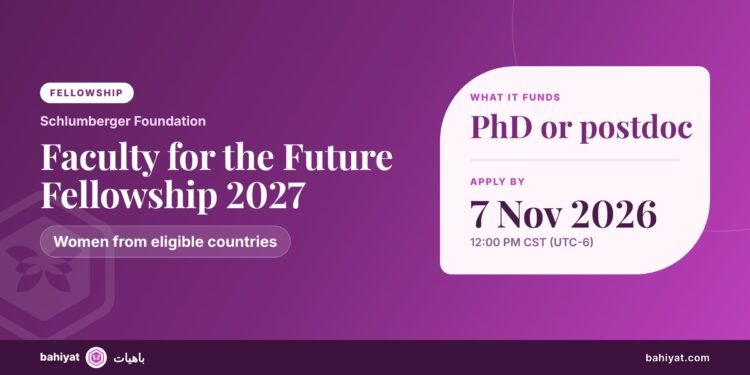
The Schlumberger Foundation’s Faculty for the Future programme funds women from eligible low- and middle-income countries to pursue a PhD or postdoctoral research in STEM at a leading university abroad. New applications for the 2027 fellowships close on 7 November 2026 at 12:00 noon US Central Standard Time (UTC-6). If you are a researcher from Morocco, Iraq, Palestine or another listed country, start by checking the country list.
At a glance
| Deadline | 7 November 2026, 12:00 noon US Central Standard Time (UTC-6), which is 18:00 UTC |
| Who can apply | Women holding the nationality of an eligible low- or middle-income country, preparing for a PhD or postdoctoral research in a STEM field |
| What the fellowship funds | A PhD or postdoctoral research at a leading university or institute abroad (master’s studies are not funded) |
| Award amount | Not stated on the pages we reviewed |
| Cost to apply | No fee is mentioned on the official pages |
| Official link | fftf.slb.com |
Who can apply
The official summary of eligibility criteria (for the 2026 to 2027 programme year) sets these criteria:
- You are a woman holding the nationality of a low- or middle-income country where women’s participation in STEM is low. Dual nationality with a developed country is not allowed.
- You are preparing for a PhD or postdoctoral research in a science, technology, engineering or mathematics (STEM) field.
- You are enrolled at, admitted to, or have applied to a leading university or research institute abroad.
- You have an excellent academic record and proven teaching experience in your home country.
- You are ready to return to your country or region after your studies to work in an academic or research position in STEM, in entrepreneurship that addresses the region’s challenges, or in policymaking.
- You show leadership skills, active community engagement and a record of encouraging young people, especially girls and women, to enter STEM.
The same document includes the list of eligible countries. Arab countries on it include the Comoros, Djibouti, Iraq, Libya, Mauritania, Morocco, Palestine, Somalia, Sudan, Syria and Yemen. Check the full list yourself before investing time in an application.
What the fellowship offers
The programme supports gender equality in STEM by funding talented women from low- and middle-income countries to pursue a PhD or postdoctoral research at leading universities abroad. The official pages we reviewed do not state the value of the benefits, so we do not give any amount here. Master’s studies are not funded. To find out what the fellowship covers, see the FAQ on the programme website or write to the team at facultyforthefuture@slb.com.
How to apply
- Read the eligibility summary and check that your nationality is on the country list.
- Make sure you are enrolled at, admitted to, or have applied to a university or institute abroad.
- Create a new applicant account on the official application website. The site asks you to use Firefox or Chrome.
- Complete and submit your application before 7 November 2026 at 12:00 noon US Central Standard Time (UTC-6).
- Make sure your referees submit their letters online by 14 November 2026. They receive their login details in an automatic email.
Key dates: applications for new applicants opened on 1 September 2026, close on 7 November 2026, and reference letters are accepted until 14 November 2026.
Advice from the bahiyat team
- Start with your passport. Nationality is the deciding condition here, and a second nationality from a developed country rules you out.
- Sort out the university side early. The criteria require a university or institute abroad where you are enrolled, admitted or have applied.
- Gather evidence of teaching and community work. Proven teaching experience and a record of encouraging girls and women into STEM are stated criteria, so collect specific examples instead of general statements.
- Make your return plan clear. Name the academic, entrepreneurial or policy role you intend to take on in your country or region.
- Tell your referees now. Their letters are due one week after applications close, so ask for them well before 7 November.
FAQ
The official pages we reviewed do not mention any fee.
No. The programme does not fund master’s studies.
Not if it is the nationality of a developed country. The eligibility summary states that dual nationality with a developed country is not allowed.
It is enough to be enrolled at, admitted to, or to have applied to a leading university or research institute abroad.