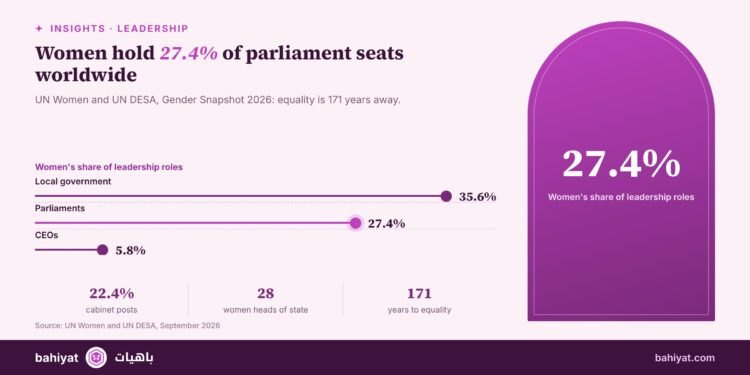
Women hold 27.4% of seats in national parliaments in 2026, up from 22.3% in 2015, but only 22.4% of cabinet positions, according to Progress on the Sustainable Development Goals: The Gender Snapshot 2026, published by UN Women and the UN Department of Economic and Social Affairs in September 2026. At the current pace, gender equality is 171 years away.
This year’s edition puts women’s leadership at the center: in parliaments, governments, courts and companies. It also shows where progress is real and where it is slipping.
About the report
| Publisher | UN Women and UN Department of Economic and Social Affairs (UN DESA) |
| Released | September 2026 |
| Title | Progress on the Sustainable Development Goals: The Gender Snapshot 2026 |
| Data covered | Global progress on gender equality across the SDGs, with a focus on women’s leadership |
| Latest edition? | Yes, as of November 2026. Published every year. |
Key findings
- Women hold 27.4% of parliamentary seats. At the pace of the last decade, parity would come in 2064; at the pace of the last five years, in 2089, according to UN Women.
- 28 women lead a state or government, up from 20 in 2020, but women’s share of cabinet posts fell to 22.4% from a peak of 23.3% in 2024.
- Of 175 chief justices worldwide, 31 are women. Women lead 19% of economic ministries and 12% of energy, natural resources and mining ministries.
- In business, women hold 30.5% of managerial positions and 5.8% of CEO roles. They make up about 22% of AI professionals, the report finds.
- One in three national gender equality mechanisms saw its institutional power erode over two years, and funding to women’s rights organizations fell 28% between 2023 and 2024.
- None of the SDG 5 targets is on track for 2030, and women have 64% of the legal rights men have, according to the report.
Women’s share of leadership roles, according to the Gender Snapshot 2026:
| Role | Women’s share |
|---|---|
| Local government seats (2025) | 35.6% |
| Managerial positions (2025) | 30.5% |
| Parliament seats (2026) | 27.4% |
| Cabinet positions (2026) | 22.4% |
| Chief justices | 31 of 175 |
| CEOs | 5.8% |
What the report means for women in the region
- Leadership changes priorities. The report finds that where women lead, gender-responsive policies get priority and progress follows across the SDGs. Every woman who steps into a decision-making role matters beyond her own career.
- Local government is the closest door. Women’s share is highest in local councils, at 35.6%. For women considering public life, local office is a realistic first step.
- The top of business is still far. With 30.5% of managers but only 5.8% of CEOs, the gap is in the last steps. Mentors, sponsors and networks make the difference there.
- AI is the field to enter now. Women are about 22% of AI professionals. Building these skills today is a way to lead in the jobs of tomorrow.
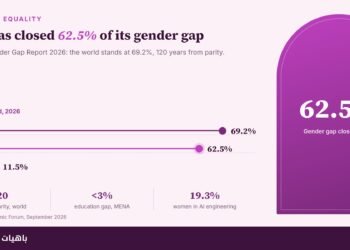
For the regional picture, see our summary of the WEF Global Gender Gap Report 2026, where MENA has closed 62.5% of its gap.
📥 Download the full report
UN Women publishes the full report free of charge in English, French and Spanish. The report is published by UN Women and UN DESA, not by Bahiyat.
FAQ
27.4%, up from 22.3% in 2015, according to the Gender Snapshot 2026.
At the current rate, achieving SDG 5 would take 171 years. None of its targets is on track for 2030.
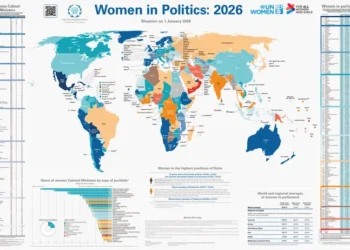
28 women were heads of state or government as of 1 January 2026, up from 20 in 2020.
UN Women and the UN Department of Economic and Social Affairs, every year.
Sources
- UN Women: The Gender Snapshot 2026, publication page
- UN Women and UN DESA: The Gender Snapshot 2026 (PDF)